Table of contents
Open Table of contents
About the Title
It’s a meme from the Dark Soul community. In the Dark Soul series, there are a lot of single-direction doors in the mazes. To open one, players will need to go for an exploration first, then most of the time, they will go back to that single-direction door miraculously, and open a shortcut for future convenience. Most of the time it is a shortcut from the save point to the boss room.
I found the inspiration from a new game called AI Limit, which is a successful successor of Dark Soul’s map design style. The idea can be taken apart into some fundamental elements shown below.
Visual Hints
The player should notice the locked door when they first go into this area/level. This can be achieved by using visual hints. For example, in AI Limit, some of these “doors” are present as a ladder’s form, and the designer will use particle effects or lighting, even the sign on the ladder to draw players’ interest.
I made a sketch using this technique. In the sketched level, a robot NPC is sitting in the upper left corner of this level, but he’s separated by a locked single-direction door. The robot should have some interesting animation, like swinging his legs, to draw players’ interest.
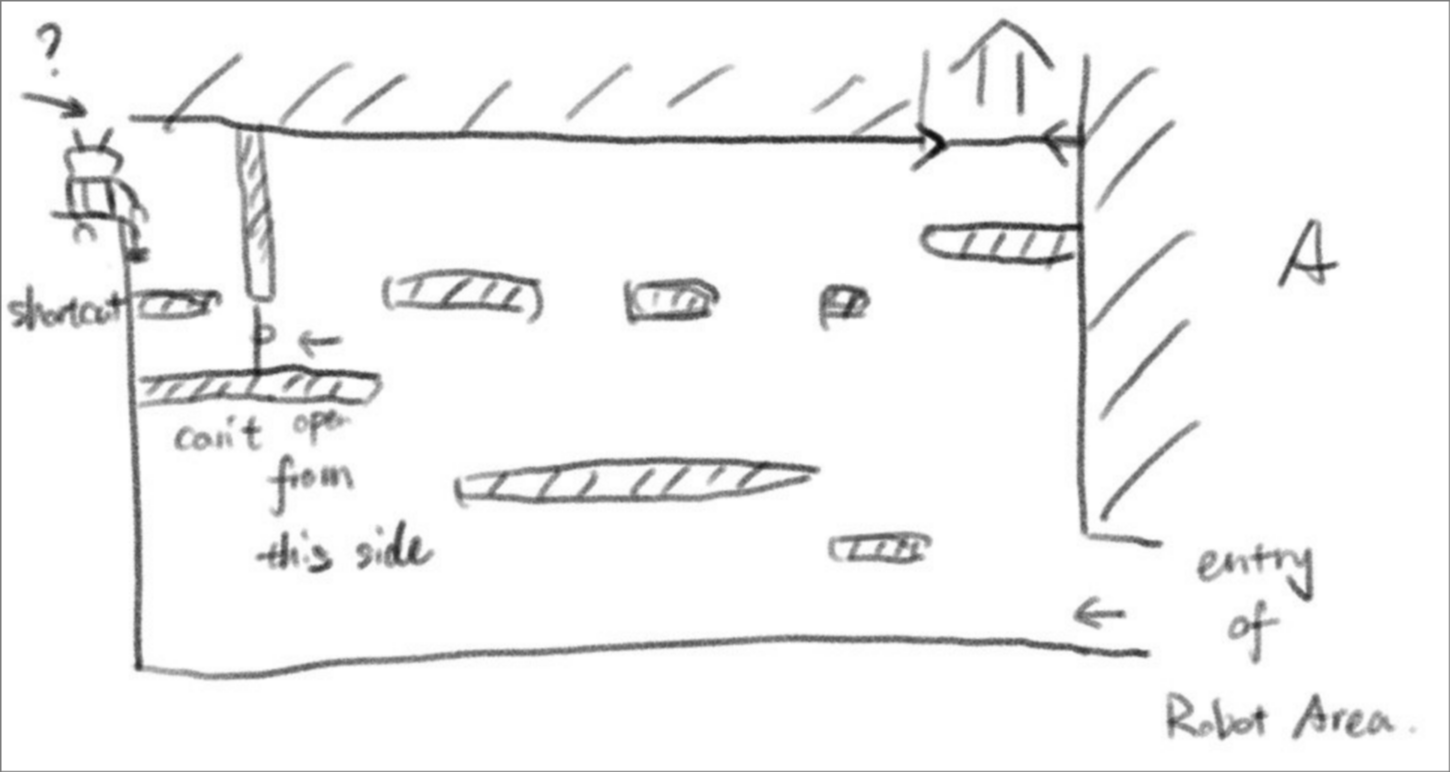
The entry to unlock this door can be hidden in another room, the spatial relation can be used as the hint. For example, in this design case, the room that is left adjacent to this room can have a hidden path in the upper right corner, connecting to the path to NPC, and a path to unlock that door.
Rooms Arrangement
Because such single-direction doors act as a shortcut once a player unlocks them, the tour until finding a shortcut can have a progressive difficulty curve, making it a little challenging.
Here is the sketch of the room arrangement that I designed for our game’s robot city (deserted city). The room mentioned in the last section is room A, and the expected exploration order is A-B-C-D here. The difficulty of every puzzle in this room should rise gradually, which suggests room D has the hardest challenging puzzle.
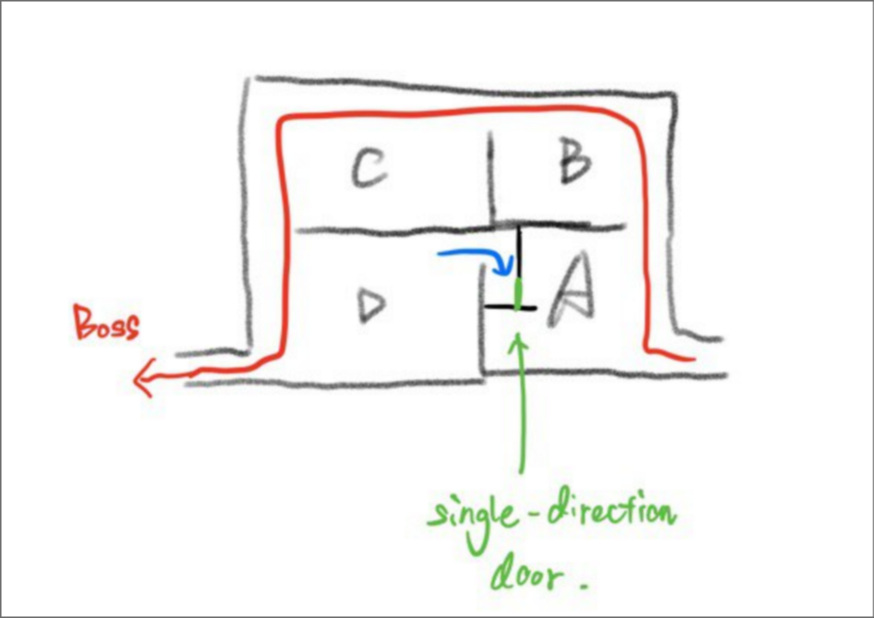
In this situation, after a player passes room D and finds the path to unlock this single-direction door, the door acts like a period, a temporary ending of the tour. It’s also a shortcut that effectively connects savepoint to the boss room, without repeating passing A-B-C-D again.
Overall Map Structure
First, we were discussing to make the map of our game composed of rooms, and every room has a puzzle that requires players to utilize the abilities of the main character Russ. However, using this design requires a lot of map designing work, and play testing every puzzle to make sure they fit into the proper difficulty category.
Finally, we just built a monolith huge room as the map, embedded some puzzles, and filled the remaining area with some common patterns in platformer games. That makes our game a bit like a 2D platformer open world but works surprisingly well.